They’re believed to accumulate and annihilate in the Sun’s core.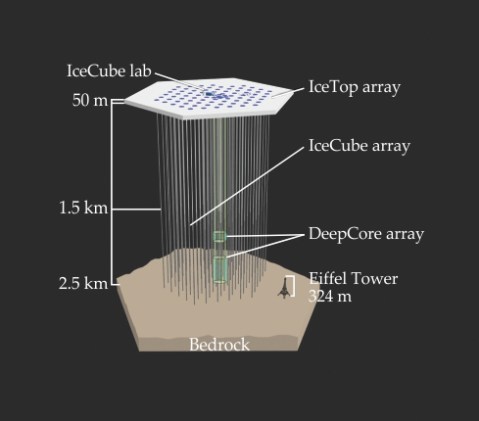
The prevailing cosmology asserts that ordinary matter, made of protons and neutrons, accounts for only about one-sixth of the mass density of the universe. The rest is presumed to be dark matter consisting of some still undiscovered heavy-particle species impervious to electromagnetic and strong-nuclear interactions.
Thus they’re called WIMPs—weakly interacting massive particles. Theoretical extensions of particle theory’s standard model that invoke a supersymmetry between fundamental bosons and fermions predict just such particles. But the great range of predicted weak-interaction strengths and masses—from 10 to 1000 times the proton mass—complicates the search for WIMPs.
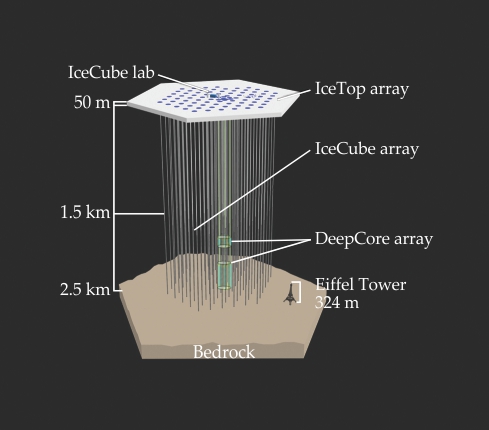
That search has recently been joined by the gargantuan IceCube detector, a cubic kilometer of instrumented ice deep under the South Pole, as shown in the figure. The collaboration spent a full year looking for high-energy neutrinos from the mutual annihilation of WIMPs gravitationally trapped in the Sun’s core.
They found no excess above the expected background of spurious events due to cosmic-ray showers in the Earth’s atmosphere. But based on that null result, they now report the most stringent limits yet on the parameter space of supersymmetric theories that might account for dark matter. (M. G. Aartsen et al., IceCube collaboration, Phys. Rev. Lett., in press, http://arxiv.org/abs/1212.4097.)

 Alan Omar
Leave a comment